
Integrating Cultural Layers into Workplace Culture Design: Six Lessons from My Certification Journey
How I blended my cross-cultural expertise with the powerful Culture Design Canvas to help teams make unspoken expectations visible — before co-creating rituals, values, and norms.
1. Cross-Cultural Frameworks: Powerful Insights, Practical Limits
For over a decade, I’ve been using powerful cultural models and frameworks such as Hofstede’s 6D model of national cultures [1] and cultural clustering [2] to help organisations and professionals succeed across borders.
Cross-cultural models are research-based frameworks that describe the invisible value systems and behavioural norms that form the rulebook for any given country or country clusters, and reveal where we, as individuals or organisations, find ourselves within that context. This stands in contrast to assuming that what works in your home country will also work in a new market, or that neighbouring countries can be treated the same simply because of geography.
With these cultural models on national cultures, I have supported companies in negotiating more effectively in foreign markets, helped customer service teams reduce friction with clients from different cultural backgrounds, enabled expats to thrive in new environments, and guided leaders to manage diverse teams with an inclusive approach.
Understanding cultural backgrounds has not only made me a better leader of international teams during my years abroad, but has also allowed me in my consulting work to give team leaders, professionals, and organisations a clearer view of how their own cultural background shapes interactions in the specific international contexts they face.
Yet, as powerful as these frameworks are, I often found myself wishing for something practical when helping organisations design their workplace or team culture. Cross-cultural frameworks offer invaluable insight into the why behind differing behaviours and expectations, but they are not designed to guide the how of building workplace culture together in a specific team or organisation. I needed a framework that could bridge that gap and support teams in designing their own workplace culture in practice, grounded in their real context.
2. From Insight to Action: Tools for Workplace Culture Design
So, I was looking for a practical yet tailored way to make workplace culture visible and actionable at the organisational and team level. That search led me to Fearless Culture methods [3] as a great basis for workplace culture design. I first completed the master classes of mapping and designing workplace culture— starting out curious, and finishing convinced. Convinced that these tools could give me exactly what I had been searching for to support companies.
That’s why I decided to go further: to gain Fearless Culture certification and become a Fearless Culture Associate, so I could fully integrate this approach into my work.
At the heart of the approach is the Culture Design Canvas — a framework that translates workplace culture into a system and practices organisations and teams can work with.
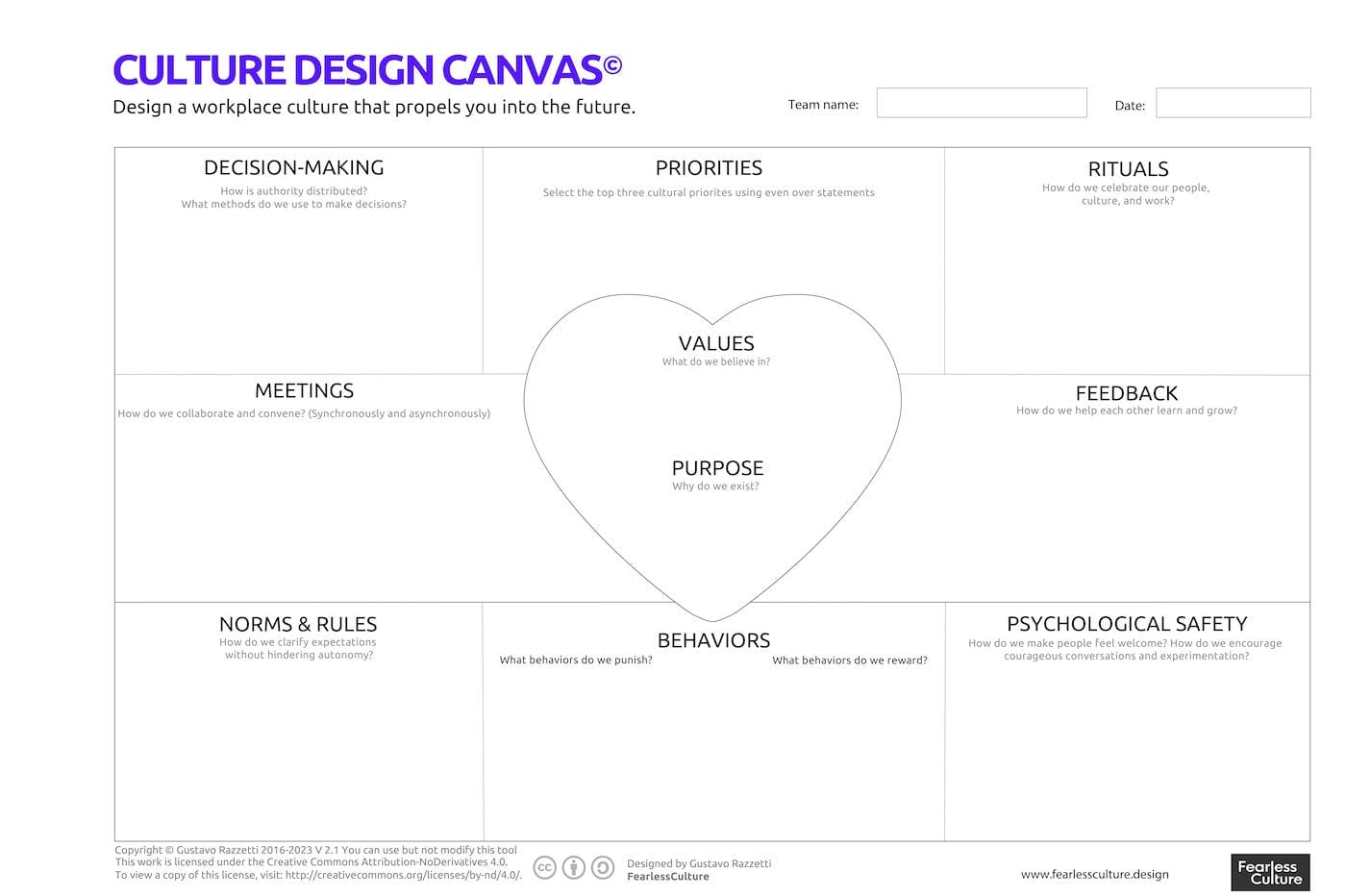
What makes the Culture Design Canvas unique is that it provides a structured way for organisations to talk about culture — turning an often intangible topic into focused, facilitated conversations that lead to alignment and action.
This makes the culture design process practical and inclusive, ensuring teams can immediately turn their shared insights into meaningful ways of working.
The Canvas guides organisations and teams to map and design three essential areas and their sub-sections:
Alignment (The Core): defining purpose, values, priorities, and behaviours.
Belonging ( Emotional Culture): creating meaningful rituals, psychological safety, and healthy feedback practices.
Collaboration (Functional Culture): shaping decision-making, meeting practices, and the norms and rules of working together.
Putting the Canvas into practice showed me how powerfully it works, and it also highlighted how crucial it is to intentionally integrate the national value layer when designing workplace culture for multicultural teams. Recognising how these two layers reinforce one another set the stage for one of the most important insights of my journey.
3. Why the National Value Layer Matters in Workplace Culture Design: A Turning Point
The Culture designer certification focused on equipping me with better skills as a workplace culture design facilitator: through self-reflection, experimenting with my facilitation style, and learning to design better sessions. The global peer community enriched the journey with diverse perspectives. Overall, the certification deepened my facilitation practice, clarified my approach, and sharpened my ability to guide complex conversations.
Working with real teams during the certification is where this learning truly took shape — and where one specific session shifted my perspective.
Early in my certification journey, I had a moment that confirmed exactly why this work matters so much. I was facilitating an Alignment session with the founders of a newly established company expanding globally.
Together, we explored their purpose, core values, priorities, and the behaviours they wanted to reward or discourage. The process flowed smoothly. The founders were engaged and aligned around what they wanted their workplace culture to stand for.
Then one of them raised a set of questions that cut straight to the heart of organisational culture design:
“Would this kind of purpose statement feel acceptable in all cultures?
How would these values resonate with close partners and subcontractors from different cultural backgrounds?
Could any of the designed elements create friction for an international team?”
Far from disrupting the session, these questions deepened it. They revealed how even when a team is clear and aligned on its shared values, those values can still be interpreted very differently across cultural backgrounds. Words like honesty, integrity, or openness don’t carry identical meanings everywhere — and often manifest in entirely different behavioural forms.
That was the moment I realised that in multicultural teams, it is never wise to overlook the impact of national culture in these conversations. The deep cultural value systems shape how people interpret workplace practices — from decision-making to feedback — and without acknowledging them, teams risk creating a culture that appears aligned on paper but feels misaligned in reality.
4. Bridging Two Cultural Layers
It’s useful to pause here, because when we speak about “culture,” we often mix two distinct layers. National culture reflects the deep value systems people grow up with, while workplace culture is the shared way people interact and work together to deliver the organisation’s strategy and mission, whether intentionally designed or not. Both shape behaviour, but they operate on different layers and influence team dynamics in different ways.
Culture on a national level is a shared meaning system, a kind of social programming of the mind that guides what feels right or wrong and what behaviours are socially acceptable. These deeply ingrained, often invisible cultural scripts influence how people interpret core workplace concepts such as responsibility, transparency, respect, and collaboration.
These cultural scripts extend into the workplace, shaping norms, leadership styles, and ideas of professionalism. How decisions are made, how much structure is expected, and how authority is exercised often reflect broader national values. In Germany, for example, an emphasis on precision, clear processes, and careful planning mirrors a cultural preference for structure and predictability — practices that may feel natural to some, but culturally specific to others.
That’s why multicultural teams can encounter challenges that remain hidden for a long time. Even when a team agrees on shared values, people’s mental images of what those values look like in everyday work can differ significantly. What feels honest and direct in one culture may feel blunt or disrespectful in another.
And these are not abstract. They show up in daily routines and unspoken expectations — in how meetings are run, how decisions are made, or what “good communication” looks like. Left unspoken, they can lead to misunderstandings that feel personal even though the root cause is cultural, not individual.
This is why bringing workplace culture design and national culture values into the same conversation makes such a difference. It creates room for curiosity, empathy, and real dialogue — allowing teams to compare expectations, explore assumptions, and build shared ways of working that feel authentic to everyone involved.
That exchange with the founders became an a-ha moment for me. It showed just how valuable it is to bridge the insights of the Culture Design Canvas with conversations about cultural backgrounds and expectations. Doing so makes the process even more inclusive and equips teams to design a culture that not only reflects their intentions but also resonates across the diverse realities of their members and stakeholders, not just one dominant perspective.
The workshop experience also clarified the role I want to play as a facilitator: combining the powerful structure of the Culture Design Canvas with the insights of cross-cultural frameworks. Together, the two layers help teams move from shared intentions to shared understanding — the foundation of any effective workplace culture.
5. The Business Case for Integrating Both Cultural Layers
Decades of research show that diversity improves performance only when teams create clarity around expectations and ways of working. Without that clarity, cultural differences can slow execution or even create conflict. Bringing both cultural layers into the conversation helps teams build that clarity from the start, beginning with questions like:
What does respectful behaviour look like across cultures represented in the team?
How are decisions typically made and communicated across these cultures?
What does constructive feedback sound like across the different backgrounds?
How is a leader expected to act in your culture — as a facilitator, consultant, or decision-maker?
To operationalise this in practice, I developed a conversational tool during the certification that helps teams surface their underlying cultural expectations across each element of the Culture Design Canvas. These upfront insights improve the shared understanding of the differing culturally shaped expectations before the design work begins.
Exploring these questions complements the workplace culture design work by ensuring that when teams co-create values, rituals, and ways of working, they do so with a shared understanding that honours the diversity in the room. This approach increases awareness of self and others, fosters inclusivity, accelerates trust, and lays the foundation for a workplace culture that lasts.
Why does this matter for organisations? Because when both national cultural values and workplace culture practices are considered together, the benefits translate into measurable business results.
Research consistently shows that diverse and inclusive teams perform better. McKinsey & Company’s Diversity Wins report [4] found that companies in the top quartile for cultural and ethnic diversity are 36% more likely to outperform financially. But diversity is not a performance guarantee — without aligned expectations and agreed ways of working, culturally diverse organisations and teams risk miscommunication, slowed decision-making, and friction.
In my experience, teams that take time to uncover their cultural assumptions early unlock three major advantages:
Stronger belonging and psychological safety: everyone feels seen, heard, valued and able to contribute.
Richer collaboration and problem-solving: different perspectives become a source of innovation rather than friction.
Faster integration of new members: aligned expectations around communication, decision-making, and collaboration make it easier for people to join and contribute quickly.
By weaving both cultural layers into the workplace culture design process — guided by the Culture Design Canvas framework — international organisations can build workplaces with stronger alignment, deeper belonging, and inclusive ways of working that support effective collaboration in today’s complex environment.
6. Conclusion: Making the Invisible Visible
Looking back, completing the Fearless Culture Designer Certification became a personal turning point in how I support multicultural organisations. It strengthened my ability to combine cross-cultural expertise with workplace culture design in a way that helps teams address both cultural layers — national and workplace — early, long before misunderstandings or misalignment take hold.
Working with both layers fundamentally changed my facilitation approach and the way multicultural organisations and teams experience the culture design process. When they explore these layers openly, they can uncover implicit expectations and co-create values, rituals, and ways of working that genuinely reflect their diversity and context.
As organisations grow globally and teams become increasingly diverse, two questions become essential:
👉 How do people from different cultural backgrounds experience your workplace culture practices — respect, responsibility, collaboration, and communication?
👉 What kind of culture will your team need to succeed together in the future?
When leaders are willing to explore national culture and workplace culture together, they unlock stronger trust, faster innovation, and more resilient teamwork. Most importantly, they create workplaces where people genuinely feel they belong.
Just as that founder’s questions deepened our workshop, asking these questions early is what enables teams to design a culture that is aligned, adaptive, and capable of navigating the complexity of the future.
If workplace culture development is on your agenda and your teams are international, don’t build it on assumptions. Let’s talk.
Sources:
[1] Geert Hofstede, Gert Jan Hofstede and Michael Minkov: Cultures and Organizations: Software of the Mind. New York: McGraw-Hill USA, 2010. Amazon.
[2] Huib Wursten, Erika Visser (editor), and Pia Kähärä (editor): The 7 Mental Images of National Culture: Leading and Managing in a Globalized World. 2019. Amazon.
[3] Gustavo Razzetti: Remote Not Distant: Design a Company Culture That Will Help You Thrive in a Hybrid Workplace. Liberationist, 2022. Amazon.
[4] McKinsey & Company: Diversity wins. How inclusion matters. 2020. PDF.